
Apicoectomy in Downtown Toronto
Explore apicoectomy treatment in downtown Toronto. This minor surgical procedure can help treat a persistent infection at the root tip and, when appropriate, save your natural tooth. Book a consultation to find out if it’s right for you.

What Is an Apicoectomy?
An apicoectomy, also known as root-end surgery, is a microsurgical procedure to treat persistent infection at the tip of a tooth’s root. It’s often performed after a failed root canal, when infection lingers or returns.
Instead of removing the entire tooth, we remove only the infected root tip (apex), clean the surrounding area, and seal it, with the goal of keeping your natural tooth.

Book Your Apicoectomy Consultation Today
Don’t wait until extraction is your only option. Choose King West Dentistry for a comfortable, carefully planned apicoectomy.
What to Expect from Apicoectomy at King West Dentistry
- Microsurgical Precision: We use advanced magnification and biocompatible materials.
- Experienced Dental Team: Your treatment is planned and explained by our dentists, with referral to a registered endodontist when needed.
- Tooth Preservation Focus: We prioritize saving your natural teeth.
- Transparent Communication: Every step is explained in detail.
- Flexible Hours & Emergencies: Evening appointments Monday and Tuesday, and open Saturdays
Dr. Alireza Golabchifar

Meet Your Dentist
Dr. Alireza Golabchifar is a general dentist at King West Dentistry. At your consultation, he reviews your X-rays, explains whether an apicoectomy, root canal retreatment or another option suits your tooth, and answers your questions before any treatment begins. If your case needs a specialist, we’ll refer you to a registered endodontist.
Apicoectomy vs. Root Canal Retreatment: How They Compare
Sometimes a second root canal isn’t effective, or even possible. Here’s how apicoectomy compares.
Treatment Type | Root Canal Retreatment | Apicoectomy |
Removes Infected Tissue | Yes | Yes |
Treatment approach | Through the top of the tooth (crown re-opened) | Through the gum, at the root tip (crown left in place) |
Surgery involved | No | Yes, minor surgery |
Typical recovery | Mild soreness for a day or two | Some swelling and soreness for a few days |
Option for blocked or calcified canals | Often limited | Often suitable |
Is an Apicoectomy Right for You? Common Signs
You may need an apicoectomy if you experience:
- Persistent pain after a root canal
- Swelling or infection near a treated tooth
- A cyst or abscess at the root tip (shown on X-ray)
- Cracked root tips or calcified canals
- Recurrent infection after root canal retreatment
When Do You Need an Apicoectomy?
Answer five quick questions to see whether an apicoectomy consultation at King West Dentistry may be a good next step. 📍 Serving patients across King West, Liberty Village and downtown Toronto.
Your Apicoectomy Self-Check Result
At King West Dentistry, our dental team, including Dr. Alireza Golabchifar and Dr. Gita Amiri, uses digital imaging to check whether an apicoectomy is right for you. Book a consultation to find out.
This self-check is for general information only and is not a diagnosis. Only an exam and X-rays can confirm which treatment you need.
How Much Does Apicoectomy Cost in Downtown Toronto
The cost of an apicoectomy at King West Dentistry ranges from $900 to $1,500, depending on the tooth’s location, the complexity of the procedure, and your insurance coverage.
- Most dental insurance plans cover part of the cost under major restorative benefits.
- Our team will gladly help you check your coverage and handle the paperwork.
- We offer 0% financing plans for eligible patients. Ask us how to get started.
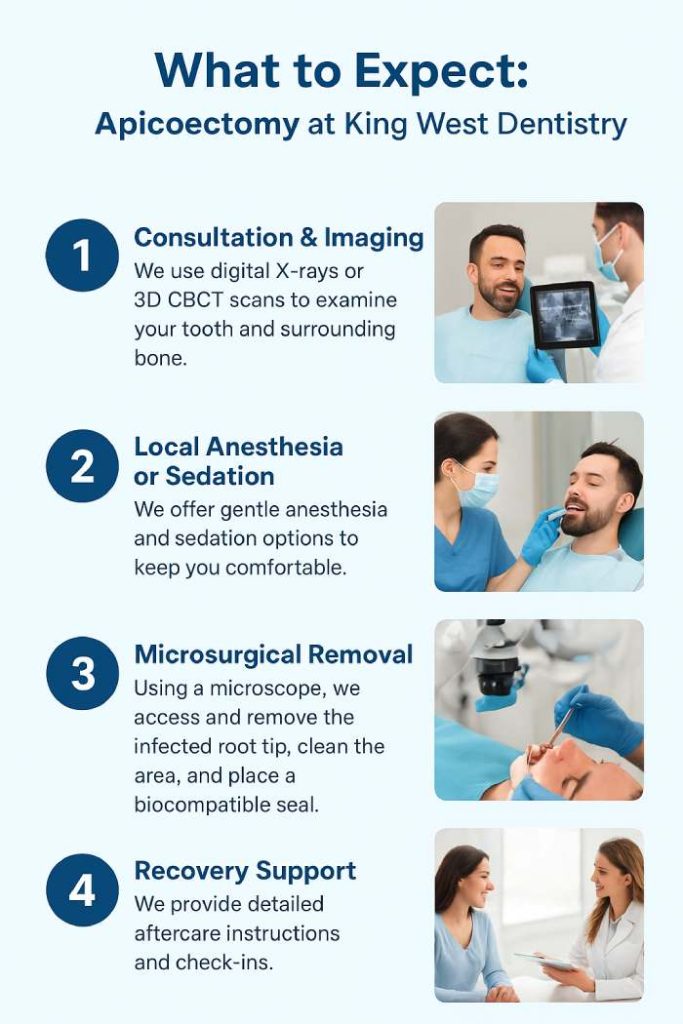
What to Expect: Apicoectomy at King West Dentistry
Step 1: Consultation & Imaging
We use digital X-rays or 3D CBCT scans to examine your tooth and surrounding bone.
Step 2: Local Anesthesia or Sedation
We offer gentle anesthesia and sedation options to keep you comfortable.
Step 3: Microsurgical Removal
Using a microscope, we access and remove the infected root tip, clean the area, and place a biocompatible seal.
Step 4: Recovery Support
We provide detailed aftercare instructions and check-ins.
Frequently Asked Questions
Is apicoectomy painful?
Not at all. We use local anesthesia and sedation to ensure a completely comfortable procedure. Most patients report only mild soreness afterward.
How long does an apicoectomy take?
On average, an apicoectomy takes about 45 to 90 minutes, depending on the location of the tooth and the complexity of the infection.
Will my insurance cover the apicoectomy?
Many dental insurance plans cover part of the cost under major restorative procedures. Our team can review your benefits and help you understand your coverage.
Is apicoectomy better than tooth extraction?
In some cases, an apicoectomy can help preserve your natural tooth and maintain your bite and oral function. Your dentist will evaluate your condition and discuss whether this option or another treatment approach is most suitable for you.
Can the infection come back after apicoectomy?
It can, although it isn’t common. Most teeth heal well after an apicoectomy, but infection can return if the tooth cracks or bacteria reach the root again. We check healing with follow-up X-rays.
